
Johan Mjallby
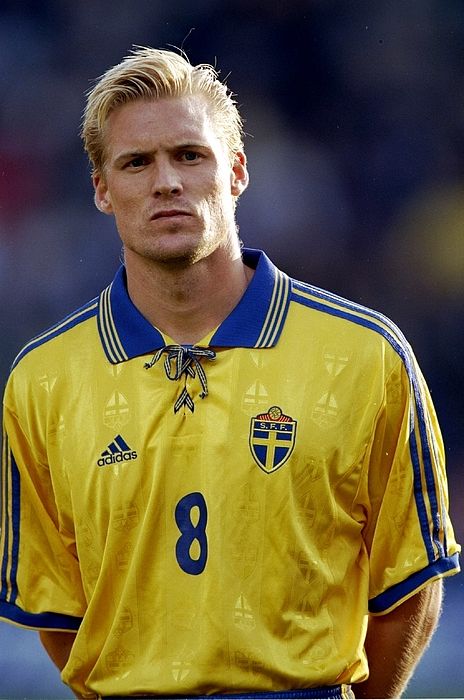
– An Extensive Biography
Early Life and Sporting Background
Karl Johan Siward Mjällby was born on 9 February 1971 in Järfälla, Stockholm County, Sweden. From an early age, he showed exceptional athletic ability and was regarded as a rare multi-sport talent. As a teenager, Mjällby competed at a high level in both football and tennis, with many believing he had the potential to turn professional in either discipline.
Ultimately, football became his chosen path, largely due to his physical presence, tactical intelligence, and natural leadership qualities. He joined AIK Solna, one of Sweden’s most prestigious clubs, progressing through their youth system before breaking into the first team in the late 1980s.
Rise with AIK and Swedish Football
Mjällby spent nearly a decade with AIK, establishing himself as one of Sweden’s most reliable defenders. Originally deployed as a defensive midfielder, he later transitioned into central defence, a move that defined his career.
During his time at AIK, he won:
Allsvenskan (Swedish League) titles
Swedish Cups
Regular European competition experience
His consistency, strength in the air, and calmness under pressure earned him national recognition and made him a fixture in the Sweden national team throughout the 1990s.
Move to Celtic FC
In November 1998, Mjällby signed for Celtic FC for a fee of approximately £1.2 million. Initially recruited as a midfielder, it quickly became apparent that his best role lay in the heart of defence.
He made an immediate impact, memorably debuting in a 5–1 victory over Rangers, a result that instantly endeared him to the Celtic support. From that point on, Mjällby became synonymous with strength, reliability, and professionalism.
Golden Era Under Martin O’Neill
The arrival of Martin O’Neill in 2000 marked the most successful period of Mjällby’s Celtic career. Operating as a commanding centre-back, he formed part of a formidable defence alongside players such as Bobo Baldé and Joos Valgaeren.
Between 2000 and 2004, Mjällby helped Celtic achieve domestic dominance, winning:
3 Scottish Premier League titles
2 Scottish Cups
2 Scottish League Cups
One of the defining moments of his club career came in 2003, when Celtic reached the UEFA Cup Final in Seville. Although Celtic narrowly lost to Porto, Mjällby’s performances throughout the campaign were widely praised, cementing his status as a big-game player.
He also wore the captain’s armband on several occasions, reflecting the trust placed in him by managers and teammates alike.
Playing Style and Reputation
Standing at 6 ft 2 in (1.88 m), Mjällby was renowned for:
Exceptional aerial dominance
Physical strength and bravery
Strong positional sense
Calm distribution from the back
Despite his imposing presence, he was not reckless and relied more on reading the game than aggressive tackling. His leadership and professionalism made him a dressing-room role model.
Among Celtic supporters, he earned the affectionate nickname “Big Dolph”, referencing his resemblance to Swedish actor Dolph Lundgren.
Injury Struggles and Departure
Unfortunately, Mjällby’s later years at Celtic were increasingly disrupted by chronic knee injuries. Despite playing through pain on numerous occasions, the physical demands of elite football eventually took their toll.
In June 2004, he left Celtic after declining a short-term contract extension, bringing an end to a six-year spell that left a lasting legacy at the club.
Later Playing Career
Mjällby briefly joined Levante in Spain, but injuries again limited his impact. He returned to Sweden and finished his playing career with AIK, retiring in 2006 at the age of 35.
International Career with Sweden
Mjällby was capped 49 times for Sweden, scoring 4 international goals. He represented his country at:
UEFA Euro 2000
2002 FIFA World Cup
UEFA Euro 2004
He also captained the national team, underlining his importance and leadership at international level.
Coaching and Life After Playing
Following retirement, Mjällby transitioned into coaching and media work. Most notably, he returned to Celtic FC as assistant manager between 2010 and 2014, working under Neil Lennon during another successful period for the club.
Outside football, Mjällby has pursued personal development challenges and media projects in Sweden, including a high-profile television series focused on Shaolin training and mental resilience, highlighting his interest in discipline, fitness, and self-improvement.
Legacy
Johan Mjällby is remembered as:
One of Celtic’s most dependable modern defenders
A leader during a historic era of domestic and European success
A respected international footballer for Sweden
A figure who embodied professionalism, toughness, and humility
Among Celtic supporters, he remains a cult hero and a symbol of the resilience and determination that defined the club’s early-2000s resurgence.